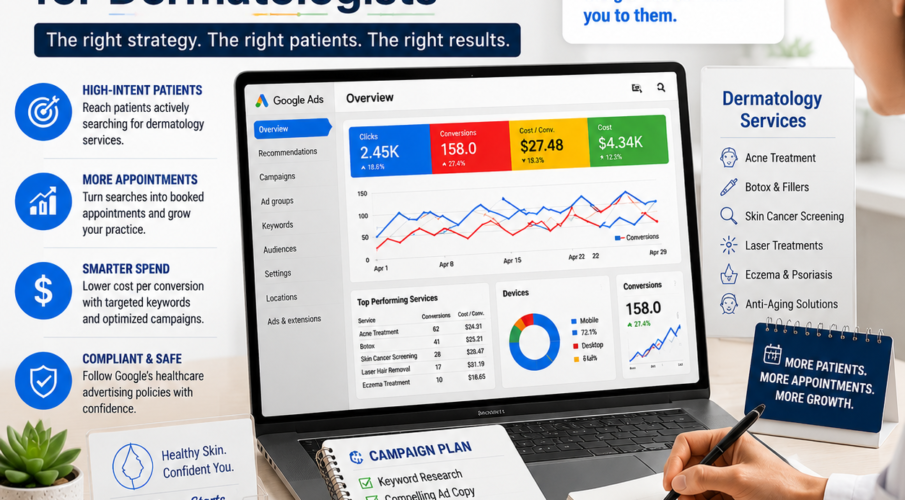
Google Ads Strategies for Dermatologists That Actually Fill Appointments
Your schedule has open slots, and patients nearby are actively searching for a dermatologist right now. Using the right Google Ads Strategies for Dermatologists can bridge that gap helping you fill appointments efficiently instead of letting your budget go to waste
The challenge is that most dermatology practices either avoid Google Ads entirely because they seem complicated, or they run campaigns that look fine on the surface but convert poorly. Poor targeting, weak landing pages, and bids placed on the wrong keywords — these aren’t rare mistakes. They’re the default.
This guide is different. It won’t hand you a generic checklist. Instead, it walks through the specific strategies that work for dermatology practices in competitive U.S. markets: how to structure your campaigns, which keywords to pursue, how to handle the nuances of medical advertising on Google, and how to measure whether your spend is actually doing anything.
If you want to stop guessing and start filling appointments consistently, keep reading.
Why Google Ads Works Differently for Dermatologists
Dermatology occupies an interesting position in healthcare marketing. Unlike emergency services, people plan their dermatology visits. They research symptoms, compare providers, read reviews, and then make a decision. That research journey runs almost entirely through Google.
This makes search advertising unusually powerful. You’re not interrupting someone who isn’t interested — you’re showing up exactly when they type “dermatologist near me” or “best acne treatment in [city].” The intent is already there. Your job is to show up with a compelling, trustworthy ad and a landing page that makes booking easy.
But there’s a catch. Google classifies healthcare advertising under its sensitive category policies. This affects what claims you can make, which ad formats are available, and how remarketing works. Navigating these restrictions isn’t difficult, but ignoring them leads to disapproved ads or, worse, account suspensions.
What Makes Dermatology Different from General Healthcare Advertising
Most dermatology services fall into two buckets: medical (acne treatment, eczema, skin cancer screenings) and cosmetic (Botox, fillers, laser resurfacing, chemical peels). The distinction matters because:
- Medical services often have insurance-connected patients with different search behavior
- Cosmetic services attract self-pay patients who research extensively before committing
- The value per patient conversion is dramatically different across these categories
- Each service type benefits from its own campaign structure and messaging
Start With the Right Campaign Structure
The most expensive mistake in Google Ads is treating a campaign like a single bucket. Dermatologists who see poor results are often running one campaign with mixed keywords, mixed intent, and no ability to identify what’s actually working.
A well-structured account separates services, audiences, and intent levels so you can optimize each independently.
Recommended Campaign Structure for Dermatology Practices
Here’s how to organize a dermatology Google Ads account for maximum clarity and control:
Campaign 1: Core Medical Services
- Ad groups: Acne treatment, eczema care, psoriasis, skin cancer screening, rosacea
- Focus: Insurance-friendly messaging, condition-specific keywords
- Bid strategy: Target CPA once you have 30+ conversions/month, otherwise Manual CPC
Campaign 2: Cosmetic Dermatology
- Ad groups: Botox, dermal fillers, laser hair removal, chemical peels, microneedling
- Focus: Outcome-focused messaging, before/after results (where allowed), pricing signals
- Bid strategy: Maximize conversions once data is collected
Campaign 3: Brand + Competitor Awareness
- Ad groups: Practice name, key providers, local brand terms
- Focus: Brand protection, capturing competitors’ branded searchers
- Bid strategy: Low CPC — these clicks are cheap and convert wel
Campaign 4: General Local Visibility
- Ad groups: “Dermatologist near me”, “skin doctor in [city]”, general appointment-booking terms
- Focus: Broad top-of-funnel capture for high-volume local searches
This structure lets you control budget at the campaign level, adjust bids per service type, and quickly see which areas of your practice are generating the best return.
Keyword Strategy: Targeting Patients Who Are Ready to Book
Keyword selection is where most dermatology campaigns live or die. The goal isn’t to appear for as many searches as possible — it’s to appear for the searches that lead to actual appointments.
High-Intent Keywords Worth Bidding On
These are searches from people actively looking to schedule or make a decision:
- “Dermatologist [city name]”
- “Book dermatology appointment near me”
- “Best dermatologist for acne [city]”
- “Botox dermatologist near me”
- “Skin cancer screening [city]”
- “Eczema specialist near me”
- “Cosmetic dermatologist [city/neighborhood]”
Informational Keywords — Handle With Care
Terms like “how to treat acne” or “what is rosacea” come from people in research mode, not booking mode. These are cheaper clicks but convert at a fraction of the rate. If you bid on them, segment them into a separate campaign with a lower bid and a landing page that gently nudges people toward booking a consultation.
Negative Keywords: The Most Underrated Part of Any Campaign
Negative keywords prevent your ads from showing on irrelevant searches. For dermatology, build your negative keyword list before your campaign even goes live. Common negatives to include:
- “free” — attracts patients expecting no-cost services
- “veterinary” / “pet skin” — non-human searches that get mixed in
- “DIY” / “home remedy” — research intent, not appointment intent
- “jobs” / “careers” / “salary” — people looking for employment
- “school” / “training” / “courses” — people looking for dermatology education
- Competitor names (unless running a competitor campaign intentionally)
Review your Search Terms report weekly in the early weeks of a campaign. This report shows the actual queries that triggered your ads — and it will surface irrelevant terms you never anticipated.
Match Types: Use Phrase and Exact, Limit Broad
Google’s broad match has improved with AI, but for medical advertisers with limited budgets, it remains risky. Phrase match and exact match give you control without sacrificing too much reach. Start there, expand carefully, and let data guide any move toward broad match.
Writing Ads That Convert — Without Overpromising
Google’s healthcare advertising policies prohibit certain claims. You cannot make personalized health claims, guarantee outcomes, or use before/after imagery in specific ad formats. But within those guardrails, there’s still a lot of room to write ads that stand out
The Anatomy of a High-Performing Dermatology Ad
Responsive Search Ads (RSAs) are the standard format now. You provide up to 15 headlines and 4 descriptions, and Google tests combinations. Here’s how to write them well:
Strong Headline Formulas:
- [Service] in [City] — Board-Certified Dermatologist
- New Patients Welcome — Same-Week Appointments
- Acne, Eczema & Cosmetic Skin Care — Book Online
- Over [X] Years Serving [City] Patients
- Accepting Most Insurance Plans — Call Today
Description Best Practices:
- Lead with a patient benefit, not a feature of your practice
- Include a clear call to action: “Book your appointment online in minutes.”
- Mention any differentiators: online booking, telehealth availability, extended hours
- Keep it readable — short sentences, no jargon
Ad Extensions: Use All That Apply
Ad extensions don’t cost extra and expand how your ad looks on the page. For dermatology practices, prioritize:
- Sitelink extensions — link to specific service pages (Acne Treatment, Botox, Skin Checks)
- Call extensions — essential for practices that prefer phone bookings
- Location extensions — shows your address and map pin directly in the ad
- Lead form extensions — let patients request an appointment without leaving Google
- Structured snippet extensions — list services (“Acne, Eczema, Psoriasis, Cosmetic Skin Care”)
Landing Pages: Where Most Dermatology Campaigns Actually Fail
Here’s an uncomfortable truth: the best ad in the world can’t fix a poor landing page. Yet this is where most dermatology practices cut corners, sending paid traffic to their homepage and wondering why conversion rates are low.
Your homepage is built for multiple audiences with different goals. A patient clicking on a Botox ad doesn’t need to see everything your practice does — they need confirmation that you offer Botox, reasons to choose you, and a simple way to book.
What a High-Converting Dermatology Landing Page Looks Like
Every page in your funnel should be designed around one action. For most dermatology practices, that action is either calling to book an appointment or submitting an online appointment request.
Must-Have Elements:
- Clear headline that matches the ad (message match builds trust instantly)
- Brief description of the service and what patients can expect
- Provider credentials (board-certified, years of experience, specializations)
- Social proof — Google rating, patient count, brief testimonial excerpt
- Single, visible CTA: “Request an Appointment” or “Call Us Now”
- Phone number in the header (many patients still prefer to call)
- Short contact form — name, phone, service of interest, preferred time
- Mobile-optimized design — most local healthcare searches happen on phones
Speed Matters More Than You Think
Google uses landing page experience as part of its Quality Score calculation. A slow-loading page hurts both your ad ranking and your conversion rate. Aim for a page load time under 3 seconds on mobile. Use Google’s PageSpeed Insights tool to identify specific issues dragging your page speed down.
Bid Strategies and Budget Management for Dermatology Practices
Budget decisions in Google Ads are rarely straightforward, especially for practices new to paid search. Here’s a grounded approach to managing your spend intelligently.
How Much Should a Dermatology Practice Spend on Google Ads?
There’s no universal number, but there are useful benchmarks. In major U.S. metro areas, clicks on competitive dermatology keywords can range from $4 to $18 per click depending on your market, specialty, and time of year. Cosmetic dermatology terms (especially Botox and fillers) often sit at the higher end.
A practice just starting out should budget at minimum $1,500 to $2,500 per month to gather enough data for optimization. Running a campaign on $500/month in a competitive market means you’ll collect too few clicks to make meaningful decisions.
Choosing the Right Bid Strategy
Google Ads offers several automated bid strategies. Here’s which ones make sense at different stages:
Early Stage (0–30 conversions/month):
- Manual CPC or Enhanced CPC — gives you control while data is thin
- Set conservative bids and increase based on position data
Growth Stage (30+ conversions/month):
- Target CPA (Cost Per Acquisition) — tell Google what a new patient lead is worth
- Maximize Conversions — useful when you want to scale volume
Avoid:
- Target ROAS in the early stages — doesn’t work well for lead-gen campaigns
- Maximize Clicks — drives traffic volume, not appointment-ready patients
Dayparting and Geographic Targeting
Run your ads when your front desk can actually answer calls. If your practice operates Monday through Friday, 8am to 5pm, there’s limited value in paying for clicks at 11pm on a Sunday when no one can book.
For geographic targeting, start tight. A 10–15 mile radius around your practice is usually sufficient in suburban areas. In dense urban markets, tighten to 3–7 miles. Expand only after you have data showing patients are traveling farther to see you.
Conversion Tracking: If You’re Not Measuring, You’re Guessing
This is non-negotiable. Without conversion tracking, you cannot know which keywords, ads, or campaigns are generating actual appointments. You’re flying blind.
What to Track
- Phone calls from ads (minimum 30 seconds in duration)
- Form submissions (appointment request forms)
- Online booking completions (if you use an online scheduling tool)
- Live chat engagements that result in appointment inquiries
How to Set It Up
Google Ads has built-in call tracking. For form submissions and booking completions, you’ll need to install the Google Ads conversion tracking tag (via Google Tag Manager is cleanest) and fire it on your thank-you page after a successful submission.
If you use a practice management system with an integrated booking tool, check whether it supports Google Ads conversion tracking natively — many do.
Attribution: Understanding the Full Patient Journey
Most patients don’t book on their first visit to your site. They might click an ad, read about your practice, leave, search again, click again, and then book. Google’s default attribution model gives 100% of the credit to the last click — which can undervalue your awareness-driving campaigns.
Once you’re running multiple campaigns, explore data-driven attribution in your Google Ads settings. It distributes credit across touchpoints more accurately, giving you a clearer picture of what’s actually moving the needle.
Performance Max Campaigns: Proceed With Caution
Google has been pushing Performance Max campaigns aggressively. These use machine learning to serve ads across all of Google’s networks — Search, Display, YouTube, Gmail, Maps — using a single campaign.
For dermatology practices, Performance Max can work, but it comes with trade-offs. You give up significant control over where your ads appear and what search terms trigger them. For practices with smaller budgets, this lack of transparency can be costly.
When Performance Max Makes Sense for Dermatologists
- You’re already running successful standard Search campaigns and want to expand reach
- You have high-quality assets (photos of your practice, provider headshots, short videos)
- Your account has strong conversion data for Google’s AI to optimize against
- You have budget to test without it cannibalizing your core Search campaigns
When to Skip It
- You’re new to Google Ads and still learning what converts
- Your budget is under $2,000/month and every dollar needs to count
- You don’t have creative assets (Performance Max underperforms with auto-generated creative)
Local Service Ads: Google’s Other Powerful Tool for Dermatologists
Many dermatologists overlook Local Service Ads (LSAs), which appear above standard Google Ads and organic results with a “Google Screened” or “Google Guaranteed” badge. Unlike traditional Google Ads, LSAs charge per lead, not per click — you only pay when a patient contacts you through the ad.
How LSAs Work for Healthcare Providers
Healthcare providers, including dermatologists, can qualify for LSAs through Google’s verification process, which includes background checks, license verification, and insurance confirmation. Once approved, your practice appears in the LSA carousel at the top of local search results.
The major advantage: patients see your star rating, review count, years in business, and service area right in the ad. It builds trust before they even click. LSAs can work exceptionally well alongside standard Google Search campaigns, giving you two separate placements on the same results page.
Common Mistakes Dermatology Practices Make With Google Ads
These mistakes come up consistently across practices of all sizes, from solo practitioners to multi-location groups.
Sending All Traffic to the Homepage
Covered earlier, but worth reiterating: your homepage is a starting point, not a conversion machine. Create service-specific landing pages and send traffic there.
Ignoring Quality Score
Quality Score affects your ad rank and cost per click. It’s determined by expected click-through rate, ad relevance, and landing page experience. A low Quality Score means you’re paying more per click than competitors with better-aligned campaigns. Regularly review and improve underperforming ad groups.
Setting Campaigns and Leaving Them Alone
Google Ads is not a “set it and forget it” system. At minimum, check your account weekly in the first three months. Review search terms, pause irrelevant keywords, adjust bids on top performers, and test new ad copy variations regularly.
Not Testing Ad Copy
Every ad group should have at least 2–3 active ads in rotation. Without testing, you have no way to learn what messaging resonates with your specific patient population. Even small copy changes — different CTAs, different value propositions — can produce meaningful differences in conversion rates.
Ignoring Competitor Campaigns
Run a brand campaign to protect your own name. Competitors may already be bidding on your practice’s name, appearing above your organic listings when someone searches specifically for you. A branded campaign with a low budget ensures you always own your own name in paid results.
Measuring Success: KPIs That Actually Matter
Vanity metrics — impressions, clicks, high click-through rates — feel good but don’t pay the bills. Focus on the metrics that connect directly to patient revenue.
Key Metrics for Dermatology Google Ads
- Cost Per Lead (CPL) — total ad spend divided by total leads generated
- Lead-to-Appointment Rate — what percentage of leads actually become booked appointments
- Cost Per Appointment — the real metric; how much you spend per patient who shows up
- Return on Ad Spend (ROAS) — patient revenue generated per dollar of ad spend
- Conversion Rate — percentage of clicks that result in a contact or booking
For most dermatology practices, a Cost Per Lead between $35–$90 is reasonable, though this varies significantly by market and service. Cosmetic dermatology leads often cost more but carry higher lifetime value. Regularly calculate your cost per appointment and compare it against the average revenue per patient visit to understand true profitability.
Integrating Google Ads With Your Broader Digital Strategy
Google Ads doesn’t exist in isolation. Its performance is affected by — and affects — your entire digital presence. A few integration points worth addressing:
Google Business Profile
Your Google Business Profile directly affects your Local Service Ads and Google Maps visibility. Keep it current: update your hours, respond to reviews, add service information, and upload photos regularly. A well-maintained profile improves performance across all Google channels.
Website Quality
Your landing pages need fast load times, clear trust signals, and frictionless booking. If your website is outdated, slow, or difficult to navigate on mobile, no amount of ad spend will compensate. Fix foundational website issues before scaling your ad budget.
Retargeting
Google’s Display Network allows you to serve ads to people who visited your website but didn’t convert. For dermatology, retargeting is particularly useful for cosmetic services — patients often research for weeks before deciding. A retargeting campaign keeps your practice top of mind during that research period.
Note: Healthcare retargeting has specific restrictions. You cannot retarget based on specific health conditions visited. Work with a qualified digital marketing professional to ensure your retargeting setup complies with Google’s healthcare advertising policies.
Frequently Asked Questions
Q1. How long does it take for Google Ads to generate results for a dermatology practice?
Most practices start seeing clicks and initial leads within the first week. However, meaningful optimization — where you can confidently adjust bids, pause underperformers, and refine targeting — typically requires 60 to 90 days of data. Plan for a three-month learning curve before evaluating campaign performance with confidence. Practices that give up in the first 30 days rarely see what the channel is actually capable of.
Q2. Can I advertise specific cosmetic treatments like Botox and fillers on Google Ads?
Yes, you can advertise cosmetic dermatology treatments, including Botox and dermal fillers, on Google Ads. However, Google’s healthcare advertising policies restrict certain claims, and before/after images are only allowed in specific formats with appropriate disclaimers. Work within the guidelines and focus your messaging on patient outcomes and the consultation experience rather than dramatic transformation promises.
Q3. Should I manage Google Ads myself or hire an agency?
For most dermatology practices, hiring a specialist — whether a dedicated agency or a freelance paid search professional — is worth the investment. Google Ads has genuine complexity: campaign structure, keyword bidding, conversion tracking, ad policy compliance, and ongoing optimization all require time and expertise. That said, if you’re running a small practice with a tight budget, learning the basics yourself is feasible. The key is committing to regular account management rather than setting campaigns and walking away.
Q4. What is a realistic cost per new patient from Google Ads?
This varies considerably by market, specialty, and competition level. In many U.S. markets, dermatology practices pay between $60 and $150 per new patient lead from Google Ads. Factoring in lead-to-appointment rates, the actual cost per booked appointment is typically higher. Compare this against the average lifetime value of a new patient at your practice — if a new patient generates $800 to $1,500 or more in lifetime revenue, a cost per acquisition of $100 to $200 is often quite reasonable.
Q5. Do I need a separate landing page for each service I advertise?
Ideally, yes. Each campaign or ad group targeting a specific service — acne treatment, Botox, eczema care — should direct traffic to a dedicated landing page for that service. Message match (when the ad and landing page align closely) dramatically improves conversion rates and Quality Score. Sending all traffic to your homepage dilutes relevance and makes it harder for visitors to find exactly what they came for.
Conclusion
Google Ads is one of the highest-intent advertising channels available to dermatology practices. When patients type “dermatologist near me” or “Botox treatment in [city],” they’re not browsing passively — they’re actively looking for a provider. That intent makes search advertising different from almost every other digital channel.
But intent alone doesn’t convert. It takes a well-structured campaign, tightly matched keywords, ads that speak to what patients actually care about, landing pages built for one clear action, and consistent optimization to turn that intent into a booked appointment.
The practices that win with Google Ads aren’t necessarily the ones with the biggest budgets. They’re the ones that treat their campaigns as an active system that needs attention, refinement, and a clear connection to real business outcomes — not just clicks.
Start with a clean structure. Track what matters. Review your data regularly. And remember: every dollar of ad spend should be working to bring a real patient through your door.