
Privacy vs Security in Digital Advertising | What Marketers Must Know
Your ad campaign is running. Conversions look solid. Then your legal team sends a message you’ve been quietly dreading: ‘We need to talk about consent.’
Most marketing teams treat privacy and security as one blurry category — something for IT and compliance to worry about. That assumption is expensive. Confusing the two means campaigns that quietly violate consumer rights, ad tech stacks with unpatched vulnerabilities, and a brand reputation that takes years to rebuild after a single breach or regulatory action.
Privacy vs security in digital advertising isn’t a philosophical debate. It’s a practical framework every modern marketer needs — not to pass a compliance test, but to build campaigns that hold up under scrutiny, earn user trust, and actually perform.
Here’s the distinction you need, why it matters now more than ever, and what you should actually be doing about it.
Privacy and Security Are Not the Same Thing — Here’s Why That Matters
These terms get used interchangeably in boardrooms, pitch decks, and vendor conversations. They shouldn’t be.
Data Privacy: Consent, Rights, and Lawful Use
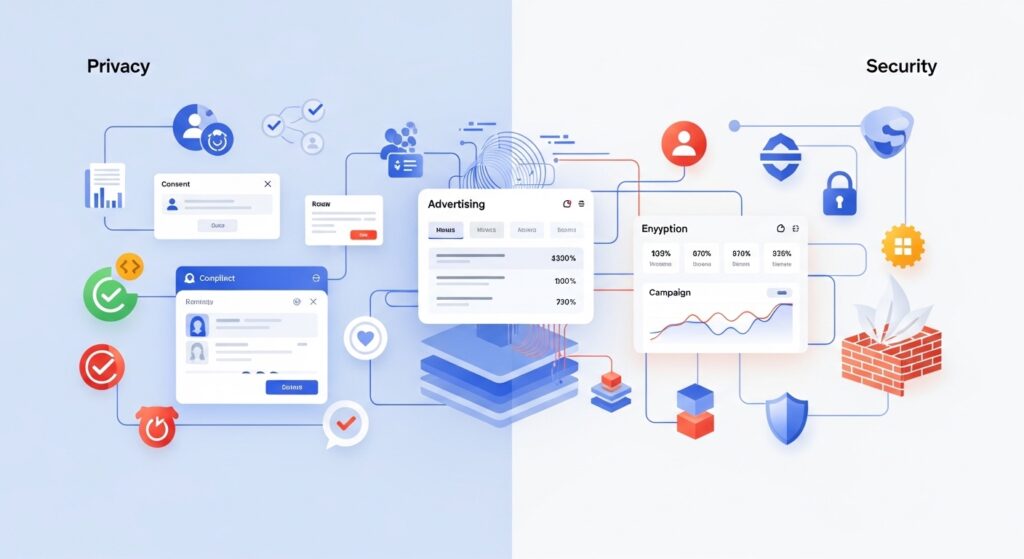
Data privacy governs how personal information is collected, used, and shared — and whether users have meaningful control over those choices. It’s fundamentally about rights: the right to know what’s being collected, the right to opt out, the right to access or delete your own data.
In digital advertising, privacy failures look like this:
• Tracking users across sites without explicit consent
• Sharing behavioral data with third-party ad networks without disclosure
• Retargeting audiences in ways that violate the terms of your data collection
• Deploying pixels or tags that fire before a user accepts your cookie banner
Data Security: Protection Against Unauthorized Access
Data security is about technical safeguards — encryption, access controls, vulnerability patching, intrusion detection. It protects data from being stolen, leaked, or manipulated by bad actors.
In digital advertising, security failures look like this:
• Ad server breaches that expose user behavioral data
• Insecure data management platform (DMP) configurations
• Third-party JavaScript tags injecting malicious code into your site
• Unencrypted audience data sitting in a cloud bucket with misconfigured permissions
The two disciplines overlap — you can’t have meaningful privacy without solid security underneath it — but they require different strategies, different tooling, and different accountability structures. A marketer who understands this distinction makes smarter decisions about both.
Why This Debate Is Urgent Right Now
The pressure on both fronts has compounded since 2018, and it’s not slowing down.
The Regulatory Wave Isn’t Over
GDPR set the standard in Europe. CCPA followed in California. Then CPRA, Virginia’s CDPA, Colorado’s CPA, Connecticut’s CTDPA. As of 2025, more than a dozen U.S. states have enacted comprehensive privacy laws, and federal legislation is actively debated. The message from regulators is consistent: consumer data rights are non-negotiable, and enforcement is real.
The FTC has expanded its focus on deceptive data practices. The IAB’s TCF (Transparency and Consent Framework) has faced legal challenges in Europe that rippled into U.S. adtech operations. Consent management platforms — once optional — have become compliance infrastructure.
Adtech regulatory compliance is no longer a legal checkbox. It’s a business continuity question.
Third-Party Cookies Are Effectively Gone
Google’s decision to eliminate third-party cookies from Chrome — after years of delays — fundamentally changed how cross-site tracking functions. The advertising industry relied on these cookies for retargeting, frequency capping, attribution, and audience building. Their loss didn’t just create a technical gap. It created a data privacy gap, too.
Cross-site tracking prevention is now a feature, not a bug, in Safari and Firefox. Chrome’s Privacy Sandbox introduced alternative APIs, but adoption has been uneven and the ecosystem is still recalibrating. Marketers who built their entire audience strategy on third-party behavioral data are rethinking their infrastructure from the ground up.
Data Breaches in Ad Tech Are Underreported
Ad tech sits at the intersection of enormous data volume and notoriously complex vendor chains. Every DSP, SSP, DMP, and measurement partner you use expands your attack surface. In 2023 and 2024, several adtech platforms disclosed breaches affecting millions of user records. Most received limited press coverage — but the legal exposure was significant.
Data breach risk in marketing is real and growing. The average cost of a data breach exceeded $4.45 million in 2023 (IBM Cost of a Data Breach Report). That number climbs when regulated personal data is involved. For a mid-size brand running programmatic at scale, a single DMP misconfiguration can become a seven-figure problem.
The Anatomy of a Privacy vs Security Failure in a Live Campaign
Let’s make this concrete with a realistic scenario — not a fabricated case study, but a plausible chain of events that reflects patterns common across the industry.
A retailer launches a programmatic retargeting campaign. They’ve built a custom audience from their email list by hashing emails and uploading them to a DSP. Their website fires a third-party pixel on the checkout confirmation page that passes purchase value data back to the ad network.
Here’s where things unravel:
• Privacy issue #1: The site’s cookie consent banner was implemented incorrectly. The pixel fires before a user accepts cookies, which means data is being collected without consent — a clear violation under CCPA and similar frameworks.
• Privacy issue #2: The hashed email list was uploaded to the DSP without reviewing the platform’s data processing agreement. The DSP’s terms allow it to use that data for model training. The retailer’s privacy policy doesn’t disclose this secondary use.
• Security issue #1: The third-party pixel script loads from an external CDN. That CDN has not been security-audited. Six months later, a malicious actor injects code into the CDN, and the pixel begins exfiltrating user session data from the checkout page.
• Security issue #2: The audience data uploaded to the DSP is stored in an S3 bucket with public read permissions. A researcher discovers it during a routine scan and discloses it to the press.
None of these failures is exotic. Each one reflects real-world vulnerabilities that appear routinely in adtech environments. And each one carries a different remediation path — consent management for the first two, technical security controls for the second pair.
First-Party Data Strategy: The Clearest Path Forward
When third-party tracking erodes and regulatory scrutiny tightens, first-party data becomes the highest-value asset in digital advertising. It’s data collected directly from users who have chosen to engage with your brand — and it’s yours.
What First-Party Data Actually Includes
• Email addresses collected via newsletter signups, account registration, or purchase flows
• On-site behavioral data captured via your own analytics (not third-party tracking scripts)
• CRM data tied to known customers
• Survey or preference data collected with explicit consent
• Loyalty program interactions
This data is more accurate than modeled third-party behavioral segments, more durable against regulatory change, and more defensible under every major privacy framework — because you have a direct consent relationship with the user.
Building the Infrastructure to Use It
First-party data strategy isn’t just about collecting more email addresses. It requires an architecture that can activate the data across channels while maintaining compliance. That means:
• A clean room environment (like Google’s Ads Data Hub, Amazon Marketing Cloud, or LiveRamp’s Data Collaboration platform) where you can match first-party data against publisher data without exposing raw personal information
• A consent management platform (CMP) that records and enforces consent signals across your tech stack
• Tag management that fires only consented tags, not everything at page load
• Customer data platform (CDP) infrastructure to unify, segment, and activate data across touchpoints
The first-party data model isn’t a workaround. It’s a more sustainable advertising model — one where user trust is the foundation rather than an afterthought.
Privacy-Enhancing Technologies: What They Are and When to Use Them
Privacy-enhancing technologies (PETs) are a category of tools designed to enable data analysis and ad targeting while minimizing exposure of personal information. They’ve become a core part of the post-cookie advertising stack.
Differential Privacy
Adds statistical noise to datasets so that individual-level data cannot be extracted from aggregate results. Google’s Privacy Sandbox APIs use differential privacy principles, as does Apple’s SKAdNetwork attribution framework. For marketers, this means measurement data may be less granular but more privacy-compliant.
Secure Multi-Party Computation (SMPC)
Allows two parties to run computations on combined datasets without either party seeing the other’s raw data. Useful for publisher-advertiser matching — determining overlap between your customer list and a publisher’s audience without sharing actual email addresses with either side.
Federated Learning
Machine learning runs on-device rather than sending raw behavioral data to a central server. Google’s original FLOC proposal (since replaced by Topics API) was built on this concept. Federated learning allows interest-based targeting without centralizing behavioral data.
User Identification and Anonymization
User identification and anonymization sits at the heart of privacy-security tension in adtech. Identity resolution providers like LiveRamp, Unified ID 2.0, and ID5 offer privacy-conscious alternatives to the cookie — using consented email hashes or probabilistic matching instead of persistent device identifiers.
The goal is to maintain addressability (being able to reach the same user across touchpoints) while reducing the personal data footprint. Done correctly, this keeps campaigns effective without accumulating sensitive behavioral records that become a liability.
Consent Management Platforms: What They Do and What to Look For
Consent management platforms (CMPs) have moved from optional to essential. A CMP is the infrastructure that collects, records, and enforces user consent preferences across your digital properties.
What a CMP Actually Manages
• Displaying consent notices that meet regulatory requirements (GDPR, CCPA, CPRA, etc.)
• Recording user choices in a consent log that can be audited
• Passing consent signals to your tag management system and ad tech stack
• Honoring opt-outs and preference changes across sessions
Choosing a CMP
Not all CMPs are equal. When evaluating options, look for:
• IAB TCF 2.2 certification for global compliance coverage
• Native integration with your tag manager (GTM, Tealium, etc.)
• Granular consent signal passing — not just ‘accepted’ or ‘declined’ but per-purpose and per-vendor consent
• A clean audit trail for consent records with timestamps
• Performance impact — a CMP that slows page load creates its own business problem
OneTrust, Usercentrics, Didomi, and Sourcepoint are among the leading platforms used by enterprise advertisers. For smaller operations, Cookiebot and Termly offer accessible entry points with solid compliance coverage.
Information Governance Frameworks for Marketing Teams
Privacy and security don’t operate in a vacuum. They sit inside a broader information governance framework — the policies, processes, and accountability structures that determine how data is handled across an organization.
For marketing teams, an information governance framework typically includes:
Data Classification
Not all marketing data carries the same risk. A framework that classifies data by sensitivity helps teams apply appropriate controls. Hashed email addresses, device IDs, behavioral event logs, and purchase histories all carry different risk profiles and should be treated differently in terms of storage, access, and sharing.
Vendor Risk Management
Every third-party tag, pixel, or API integration is a potential privacy and security risk. A vendor risk management process should include reviewing the data processing agreements (DPAs) of every ad tech vendor, auditing what data they receive, and understanding their subprocessor chains. This is not a one-time task — vendor agreements change, and so do their practices.
Incident Response
When something goes wrong — a breach, an unauthorized data disclosure, a consent management failure — you need a response protocol that’s already in place. Marketing teams are rarely included in incident response planning, which means that when a campaign-related breach occurs, the response is improvised. That improvisation has direct consequences for regulatory compliance and brand communication.
Data Minimization
The simplest privacy protection is collecting less data. Data minimization — only collecting information you have a clear use for — reduces both privacy exposure and security risk. A smaller data footprint means fewer records to protect, fewer breach notifications to send, and fewer regulatory conversations to have.
Digital Advertising Cybersecurity: The Risks Nobody Talks About
Digital advertising cybersecurity gets less attention than enterprise network security or endpoint protection, but the risk surface is significant.
Malvertising
Malvertising is the use of ad networks to deliver malware to users. Because programmatic advertising relies on automated, real-time bidding with minimal human review, bad actors can inject malicious code into ad creatives that run across legitimate publisher networks. This isn’t a theoretical risk — it’s an ongoing problem that affects major publisher sites regularly.
For advertisers, the cybersecurity risk here is reputational and legal. If your brand’s ad is used as a vector for malware delivery (even without your knowledge), the association is damaging. Brand safety tools and creative security scanning help mitigate this, but they’re not infallible.
Tag Poisoning and Script Injection
Third-party JavaScript tags are a primary attack vector for data exfiltration from advertiser websites. Once a tag is on your site, any subsequent compromise of the tag provider’s infrastructure can result in code running on your domain. This is often called a ‘supply chain attack’ in security terminology.
Tag governance — knowing exactly what scripts are on your site, who controls them, and what data they access — is the practical countermeasure. A tag audit isn’t glamorous, but it’s among the highest-ROI security actions a marketing team can take.
Ad Fraud and Data Integrity
Ad fraud (bot traffic, domain spoofing, click injection) is a security and data integrity problem. When your campaign data is polluted by fraudulent impressions and clicks, every downstream decision made from that data — audience optimization, budget allocation, creative testing — is compromised. Ad verification tools (IAS, DoubleVerify, HUMAN) are standard mitigation, but the fraud landscape evolves faster than detection does.
A Practical Privacy-Security Audit Checklist for Advertisers
Rather than abstract principles, here’s a working checklist you can bring into your next quarterly review.
Privacy Checklist
• Is your consent management platform correctly configured and actively blocking non-consented tags?
• Have you reviewed the data processing agreements for every active ad tech vendor?
• Does your privacy policy accurately describe how behavioral data is used for advertising?
• Are you honoring opt-out requests and GPC (Global Privacy Control) signals?
• Is your first-party data collection tied to a specific, disclosed purpose?
Security Checklist
• Have you audited which third-party scripts are running on your website in the last 90 days?
• Are your audience data uploads to DSPs encrypted in transit and at rest?
• Is your data management platform access controlled with role-based permissions and MFA?
• Do you have a process for reviewing vendor security incidents that could affect your campaigns?
• Is your ad server configured to serve only from whitelisted creative domains?
Most marketing teams will find gaps in at least a few of these areas. That’s not a failure — it’s the baseline. The goal is to close the most material gaps first and build toward a systematic approach.
❓ Frequently Asked Questions
Q1: What is the difference between data privacy and data security in advertising?
Data privacy governs how personal information is collected, used, and shared — including whether users have consented and whether use aligns with disclosed purposes. Data security governs technical safeguards that prevent unauthorized access to that same data. In advertising, privacy failures typically involve consent violations or unlawful data use, while security failures involve breaches, data exposure, or third-party script compromises. Both matter, but they require different remediation strategies.
Q2: How does the third-party cookie phase-out affect advertising privacy?
Third-party cookies enabled cross-site tracking — allowing advertisers to follow users across unrelated websites and build behavioral profiles. As browsers have phased them out (Safari and Firefox already block them, and Chrome has moved to Privacy Sandbox), that tracking model is breaking down. Advertisers are shifting to first-party data strategies, contextual targeting, and privacy-enhancing technologies to maintain audience targeting without relying on invasive cross-site identifiers.
Q3: What does adtech regulatory compliance require from marketers in the US?
It depends on which states your audience spans and what data you collect. Laws like CCPA/CPRA (California) and similar regulations in Virginia, Colorado, and Connecticut require clear disclosure of data collection, a mechanism for users to opt out of the sale or sharing of data, and honoring opt-out requests. At minimum, US marketers need a functional consent management platform, accurate privacy policies, and reviewed data processing agreements with every ad tech vendor.
Q4: What is a consent management platform and do I actually need one?
A consent management platform (CMP) is software that displays consent notices to users, records their choices, and passes those signals to your ad tech stack to control which tags and pixels fire. If you run advertising that involves tracking, retargeting, or behavioral data — especially for users in regulated regions like California or the EU — then yes, you need one. Operating without a CMP creates compliance, legal, and brand risks.
Q5: What are privacy-enhancing technologies and how are they used in advertising?
Privacy-enhancing technologies (PETs) are tools that enable advertising and measurement while minimizing personal data exposure. Examples include differential privacy (adding noise to aggregate data), secure multi-party computation (matching data without sharing raw records), federated learning (processing data on-device), and anonymization techniques. These are increasingly integrated into major platforms as the industry moves away from personal identifier-based targeting.
Q6: How can advertisers protect against cybersecurity risks in programmatic advertising?
Start with tag governance by auditing every third-party script on your website and setting a strict approval process. Use a consent management platform that blocks non-consented tags by default. Review the security standards of your DSP, DMP, and measurement vendors — including certifications like SOC 2. Implement ad verification tools to filter fraudulent inventory, and treat campaign data as regulated personal data, not just marketing assets.
Conclusion: The Marketers Who Get This Right Will Win
Privacy and security aren’t slowing down digital advertising — they’re restructuring it. The brands that treat compliance as a burden will always be playing catch-up. The ones that build privacy and security into their data strategy from the start will have a structural advantage: better data quality, stronger user trust, lower regulatory exposure, and ad tech infrastructure that doesn’t collapse when the next policy shift hits.
The distinction between privacy and security matters because it shapes how you diagnose problems, allocate resources, and build accountability. Consent failures and breach vulnerabilities need different owners, different tools, and different timelines. Treating them as one category means fixing neither well.
First-party data, consent infrastructure, privacy-enhancing technologies, and vendor risk management aren’t just compliance answers. They’re the building blocks of a more durable advertising model — one built on trust rather than surveillance.
The question isn’t whether to take privacy and security seriously. It’s whether you start before something forces you to.