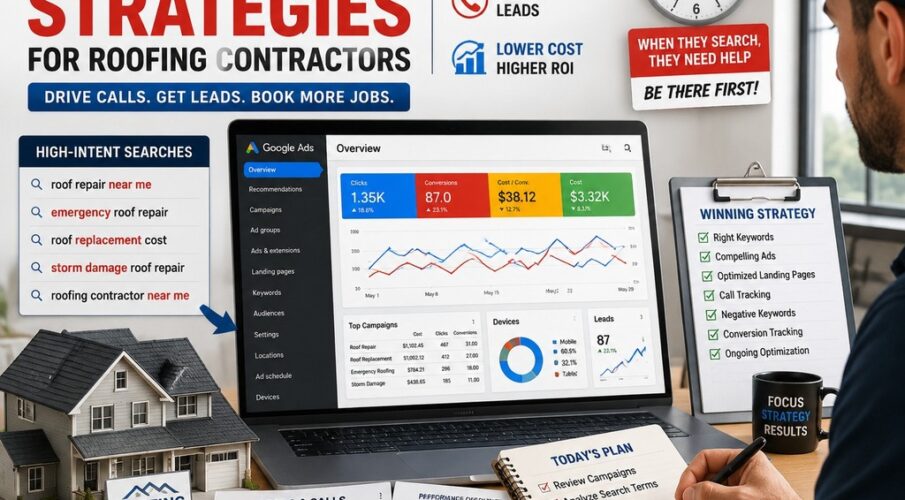
Google Ads Strategies for Roofers That Actually Work
Most roofing contractors who try Google Ads either waste money fast or give up after a few weeks. That’s not a Google problem — it’s a strategy problem. The platform works. It just punishes vague targeting, lazy ad copy, and campaigns built on guesswork.
This guide breaks down the exact Google Ads strategies for roofers that drive calls, form fills, and booked jobs — not just clicks. Whether you’re running your first campaign or trying to fix one that’s bleeding budget, you’ll find actionable steps here.
Why Google Ads Works for Roofing Businesses
Roofing is one of the best industries for Google Ads. Here’s why: people search for roofers when they need one right now. A leaking roof after a storm isn’t something a homeowner researches for weeks. They search, they call, they book. The intent is urgent and the conversion window is short.
Compare that to social media, where you’re interrupting someone’s scroll with an ad they didn’t ask to see. On Google Search, you’re showing up at the exact moment someone types ‘roof repair near me’ or ’emergency roofing contractor.’ That’s powerful positioning.
The tradeoff is cost. Roofing keywords are competitive. Clicks can run anywhere from $8 to $40+ in major metro areas. That means every part of your campaign — your keywords, your bids, your landing page, your ad copy — needs to be deliberate. One sloppy setting can drain your monthly budget in a day.
Roofing leads from Google Ads typically convert at a higher rate than leads from most other paid channels — because the searcher already has a problem and is actively looking for someone to solve it.
Set Up Your Campaign the Right Way From the Start
Before you write a single ad, the structure of your campaign determines everything. A well-built campaign keeps your data clean, your spending controlled, and your results readable.
Choose the Right Campaign Type
For most roofing contractors, Search campaigns are the foundation. You’re bidding on keywords — specific phrases people type into Google — and your ads appear in the search results.
Avoid Performance Max campaigns until you have conversion data and a budget over $3,000/month. PMax runs on automation, and automation needs historical data to work well. Without it, Google will spend your budget broadly and inefficiently.
If you’re in a highly visual market or do a lot of new roof installations (not just repairs), Display retargeting can work as a supplement — but it’s never your primary play.
Structure Your Ad Groups by Service, Not by Keyword Volume
A common mistake is cramming all roofing keywords into one ad group. Instead, separate them by intent:
- Roof repair (emergency, leaks, storm damage)
- Roof replacement (full re-roof, new construction)
- Specific materials (shingle, metal, flat, tile)
- Commercial roofing (if you serve businesses)
This structure lets you write ad copy that speaks directly to what the searcher wants — and match them to a landing page that fits. The more specific the match between search, ad, and landing page, the higher your Quality Score and the lower your cost per click.
Set Location Targeting Carefully
This sounds obvious, but it’s frequently misconfigured. Set your targeting to the specific cities, ZIP codes, or radius you actually serve. Don’t target your entire state unless you’re a multi-location operation.
Also: turn off the ‘presence or interest’ option and set it to ‘presence only.’ Otherwise Google will show your ads to people who are interested in your area but not physically there — which is useless for a local service business.
Keyword Strategy for Roofing Contractors
Your keywords are the entry point of the entire system. Get this wrong and nothing downstream matters.
Start With High-Intent Keywords
High-intent keywords signal that someone is ready to act, not just browsing. These include:
- ‘roof repair [city name]’
- ‘roofing contractor near me’
- ’emergency roof repair’
- ‘roof replacement cost’
- ‘storm damage roof repair’
These phrases are more expensive, but they convert. Someone typing ‘roof replacement cost’ is comparing options and may book within days. Someone typing ‘how long does a roof last’ is still in research mode — not worth targeting with a high bid.
Use Phrase Match and Exact Match — Not Broad
Google defaults to broad match, which means your ad can show for searches that are loosely related to your keywords. For roofing, broad match will show your ads for irrelevant queries and eat through your budget fast.
Start with phrase match and exact match:
- Phrase match: catches variations and related queries while staying relevant
- Exact match: shows only for that specific search or very close variants
As you accumulate search term data, you’ll see exactly what queries triggered your ads. That data tells you where to tighten and where there’s untapped opportunity.
Build a Strong Negative Keyword List From Day One
Negative keywords prevent your ad from showing on irrelevant searches. For roofing, add negatives like:
- ‘DIY,’ ‘how to,’ ‘free,’ ‘cheap,’ ‘roof shingles home depot’
- ‘roof rack’ (car accessories)
- ‘tin roof song,’ ‘roofing jobs’ (people looking for employment)
- Any competitor names you don’t want to appear for
Review your search term report weekly for the first month. You’ll find surprising queries that waste budget. Add them to your negative list immediately.
Writing Ads That Get Clicks and Calls
Your ad is often the first impression a potential customer has of your business. In a competitive market, a generic headline loses every time.
Headlines That Speak to Urgency and Specificity
Google allows up to 15 headlines in a Responsive Search Ad. Use them to cover different angles:
- Urgency: ’24/7 Emergency Roof Repair’
- Location: ‘Roofing Contractors in [City]’
- Social proof: ‘A+ BBB Rated Roofing Company’
- Value: ‘Free Roof Inspection — Same Day’
- Service specificity: ‘Storm Damage? We Handle Insurance Claims’
Avoid headlines like ‘Quality Roofing Services’ — they’re vague and forgettable. Every headline should tell the reader something concrete.
Use Ad Extensions to Dominate the SERP
Ad extensions (now called ‘assets’ in Google Ads) increase your ad’s visual footprint and give searchers more reasons to click. For roofing, set up:
- Call extensions: Your phone number appears directly in the ad
- Location extensions: Your address and Google Business Profile link
- Sitelink extensions: Links to specific pages — ‘Storm Damage,’ ‘Financing Available,’ ‘Get a Free Quote’
- Callout extensions: Short phrases like ‘Licensed & Insured,’ ‘Free Estimates,’ ’10-Year Warranty’
- Lead form extensions: Capture leads directly from the SERP without a landing page click
Extensions are free to add and consistently improve click-through rates. There’s no reason not to use all relevant ones.
Match Your Ad to the Landing Page
If your ad mentions storm damage repair, the landing page it goes to should be about storm damage repair — not your general homepage. This consistency builds trust instantly and improves your Quality Score, which lowers your cost per click.
A roofing homepage tries to do too much. A focused landing page for one service — with one headline, a few trust signals, and one clear call to action — converts at a much higher rate.
Bidding Strategies That Match Your Business Stage
Bidding is where most roofing campaigns go wrong. Newer advertisers often pick a bidding strategy that requires data they don’t have yet.
Start With Manual CPC or Maximize Clicks
When your campaign is new and you have no conversion data, start with Manual CPC (cost per click) or Maximize Clicks with a tight budget cap. This gives you control while you gather information.
Set your max CPC based on what a lead is worth. If a roofing job averages $8,000 and you close 1 in 10 leads, each lead is worth $800. You can afford to pay significantly more per click than most industries.
Move to Target CPA After 30+ Conversions
Once you’ve tracked at least 30 conversions — whether that’s phone calls over 60 seconds, form fills, or booked appointments — you can switch to Target CPA (cost per acquisition) bidding.
Target CPA tells Google what you’re willing to pay for a conversion. Google’s algorithm then adjusts your bids in real time across different searches, devices, and times of day. Without conversion data, this strategy guesses. With it, it works well.
Never Use ‘Maximize Conversions’ Without a Conversion Cap
Maximize Conversions without a target CPA or budget control can drain your monthly spend in days if not watched carefully. Set a daily budget, and if you switch to this strategy, monitor it daily for the first two weeks.
Tracking and Measurement: What Actually Matters
If you’re not tracking conversions properly, you’re flying blind. Too many roofing contractors track impressions and clicks but have no idea how many calls or form fills their ads are actually generating.
Set Up Google Ads Conversion Tracking
The most important conversions to track for a roofing business:
- Phone calls from ads (calls that last 60+ seconds)
- Phone calls from your website (via Google forwarding numbers)
- Form submissions on your landing pages
- Booked appointments (if your site has a scheduler)
Google Tag Manager makes this setup cleaner, especially for call tracking. If your tech setup is simple, you can also implement conversion tags directly through Google Ads.
Connect Google Ads to Google Analytics 4
Linking your Google Ads account to GA4 gives you a fuller view of post-click behavior. You can see how long visitors stay, what pages they visit, and whether they bounced immediately. This data helps you identify if a landing page problem — not an ad problem — is hurting your results.
Watch These Metrics Weekly
- Cost per conversion (your actual lead cost)
- Conversion rate by campaign and ad group
- Search impression share (how often your ads show vs. how often they could)
- Search term report (what queries are triggering your ads)
- Quality Score by keyword (below 5/10 means something needs fixing)
Seasonal and Storm-Based Campaign Adjustments
Roofing demand isn’t flat year-round. A smart Google Ads strategy accounts for seasonality and responds to sudden demand spikes — like post-storm surges.
Increase Bids Before Peak Season
In most of the US, roofing demand peaks in spring and early summer. Increase your bids and budgets 3 to 4 weeks before your typical busy season begins. Competition heats up fast, and early positioning gets you into the auction before costs spike.
Create Storm-Specific Campaigns
When a major storm hits your service area, search volume for terms like ‘hail damage roof’ and ’emergency roof tarping’ can spike 3x to 5x overnight. Have a dedicated storm response campaign ready to activate — with pre-written ads, a focused landing page, and approved budget increase ready to deploy quickly.
Time matters here. The contractors who activate first capture the majority of leads before the surge settles.
Adjust Scheduling to Match When People Actually Search
Use Google Ads ad scheduling to review when your conversions happen. Many roofing contractors find their best leads come in during business hours on weekdays. If you’re paying for midnight impressions that never convert, reduce bids during those hours or pause them entirely.
Local Service Ads vs. Google Ads: Know the Difference
Google’s Local Service Ads (LSAs) are separate from standard Google Ads and appear above the regular search ads. They’re pay-per-lead, show your reviews and license badge, and are exclusively for local service businesses including roofing contractors.
LSAs work differently from traditional Google Ads:
- You pay per lead, not per click
- Google vets you before approval — background check, license verification, insurance
- Your profile shows star ratings and years in business
- You can dispute leads that don’t match your services
For roofing, running both LSAs and standard Google Ads gives you coverage at the top of the search results page across multiple formats. Many contractors find LSAs deliver lower cost per lead, especially for repair work. The catch is limited control over targeting compared to standard campaigns.
Common Google Ads Mistakes Roofers Make
These mistakes cost roofing contractors thousands of dollars every year:
Sending All Traffic to the Homepage
Your homepage is built for general visitors. It has navigation, multiple services, and too many choices. A paid traffic visitor needs to land on a page that matches their search, has a clear headline, and a single call to action. Build dedicated landing pages.
Ignoring Mobile Experience
More than 70% of local service searches happen on mobile. If your landing page loads slowly or is hard to use on a phone, you’re wasting a significant portion of your ad spend. Test your landing page on mobile devices regularly and keep load time under three seconds.
Setting It and Forgetting It
Google Ads is not a ‘set it and forget it’ platform. Algorithms change, competitors adjust their bids, and your Quality Scores shift. A campaign that performed well in March may need adjustments by May. Block time weekly to review performance — even 30 minutes makes a difference.
Not Testing Ad Variations
Running one static ad per ad group means you learn nothing over time. Use Responsive Search Ads to test multiple headline and description combinations. Over a few weeks, Google’s system will surface the combinations that perform best, giving you real data on what messaging resonates.
Underestimating the Value of a Good Lead
Many roofing contractors are scared of their cost per click and pull back too soon. If a qualified roofing lead is worth $500 to $1,000+ to your business, paying $50 to $100 per lead is a sound investment. The math only feels wrong if you’re not tracking the full value of a booked job.
Frequently Asked Questions
Q: How much should a roofing contractor budget for Google Ads?
A: There’s no universal number, but a realistic starting budget for most local markets is $1,500 to $3,000 per month. Competitive metro areas like Dallas, Atlanta, or Phoenix may require $4,000 or more to generate consistent volume. Start with enough budget to collect meaningful data — ideally 200 to 300 clicks per month — before making major optimizations.
Q: How long does it take for Google Ads to produce results for roofers?
A: You’ll typically see initial traffic within days of launching. Meaningful performance data — enough to make confident optimization decisions — takes 4 to 6 weeks. Full campaign maturity, where bidding algorithms are well-trained and results are consistent, usually takes 2 to 3 months. Patience in the first 60 days is essential.
Q: Should roofers use Google Ads or Facebook Ads?
A: Google Ads captures active demand — people who are searching for a roofer right now. Facebook Ads reaches people who aren’t actively searching, which makes the intent lower and the conversion path longer. For most roofing contractors, Google Ads delivers faster ROI. Facebook can work for brand awareness and retargeting but shouldn’t replace search-intent campaigns.
Q: What’s a good cost per lead for roofing on Google Ads?
A: It varies by market and service type. For repair work, a cost per lead between $40 and $100 is common and profitable. For full roof replacement leads, $80 to $200 is typical in competitive markets. What matters most is your cost per booked job, not just your cost per lead — factor in your close rate when evaluating campaign performance.
Q: Do I need a separate landing page for Google Ads, or can I send traffic to my website?
A: You should use dedicated landing pages for your paid campaigns. A general website homepage has too many distractions — navigation menus, multiple services, and no singular focus. A purpose-built landing page with one clear headline, a few trust signals, and a single call to action will consistently outperform a homepage for paid traffic. The difference in conversion rate can be dramatic.
Conclusion
Running Google Ads as a roofing contractor isn’t complicated, but it does require intention. The platform rewards specificity — specific keywords, specific audiences, specific messaging, specific landing pages. Every layer of precision you add reduces wasted spend and improves your results.
The contractors winning on Google Ads aren’t spending the most. They’re spending the most strategically. They know what a lead is worth, they track every conversion, and they optimize consistently. That’s a repeatable process, not a hidden advantage.
Start with a tight campaign built around your highest-intent services. Track your calls and form fills from day one. Review your search term report weekly. Build or improve your landing pages before scaling spend. And give the campaign time to gather real data before drawing conclusions.