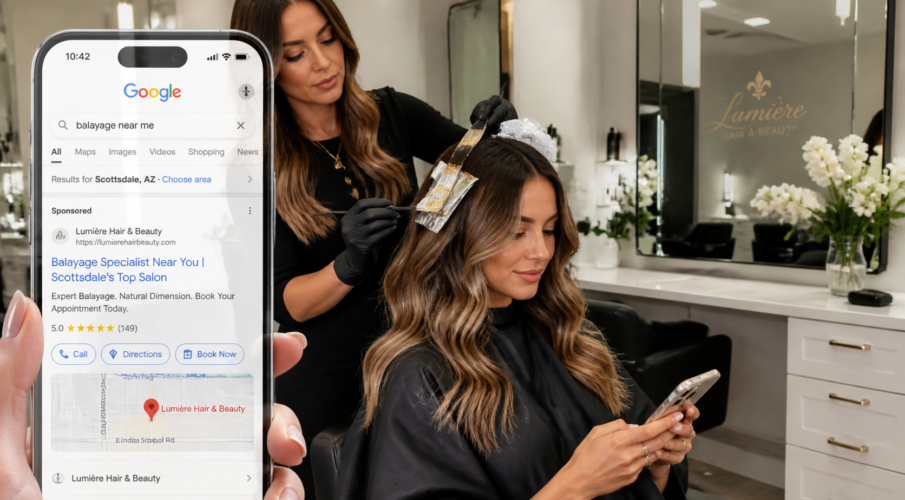
Google Ads Strategies for Hair & Beauty Salons That Actually Book Clients
Your next loyal client is already searching for you. They’re on their phone, typing “balayage near me” or “best waxing salon in Austin” — and they’re ready to book. The only question is whether your salon shows up, or your competitor’s does.
Google Ads Strategies for Hair & Beauty Salons puts your salon at the top of those results the moment someone searches. But showing up is only half the battle. The salons that actually fill their books aren’t just running ads they’re running smart ads. There’s a real difference.
This guide walks through Google Ads strategies built specifically for hair and beauty salons. You’ll learn how to target the right searches, write ads that convert, set a budget that makes sense, and track what’s actually working. No generic advice. No jargon without explanation.
This is the approach that drives bookings not just impressions.
Why Google Ads Is a Natural Fit for Salon Marketing
Not every business thrives on paid search. Salons do — and for clear reasons.
Your clients are already searching
Hair and beauty services are high-intent searches. When someone looks up “hair color salon near me” or “nail technician open Saturday,” they’re not casually browsing. They want to book. Google Ads lets you show up exactly at that moment, in front of people who’ve already decided they want what you offer.
That’s a very different audience from someone scrolling through Instagram who might like your content but isn’t planning anything. Both channels have value, but Google captures bottom-of-funnel intent that social media rarely does.
Repeat clients change the math
One of the best things about the salon business model: clients come back. A new client who loves her haircut returns every 6–8 weeks. Over a year, that’s potentially 6–8 appointments from a single acquisition.
That changes how you think about ad spend. If it costs you $35 to acquire a client who books 7 times a year at $90 a visit, that’s strong return — and it means you can afford to bid competitively when it counts.
Local targeting makes budgets go further
Google Ads lets you target by location radius — so you’re only paying to reach people within a realistic driving distance of your salon. A tightly defined geo-target means you’re not wasting impressions on people in the next city over who’ll never walk through your door.
For most salons, targeting a 5–10 mile radius is the starting point. Adjust based on your area’s density and how far your clients typically travel.
Setting Up the Right Google Ads Campaign Structure
Campaign structure determines everything downstream: who sees your ads, what they see, and what happens when they click. A messy structure wastes money. A clean one keeps you in control.
Start with Search campaigns
For most salons, Google Search campaigns should be the priority. These show text ads to people actively searching for your services. It’s the most direct path from search intent to booking.
Display and YouTube ads have their place in building brand awareness, but start with Search. You need to capture existing demand before you invest in creating new demand.
Organize by service, not by budget
A common mistake is building one big campaign for everything. Instead, separate your ad groups by service category:
- Hair services (cuts, color, highlights, balayage, keratin)
- Skincare and facial treatments
- Waxing and threading
- Nails and nail art
- Bridal and special occasion services
Each service category has different keywords, different audiences, and often different price points. Keeping them separate lets you control bids and budgets by what’s most profitable for your salon — and write more specific ad copy that speaks directly to what someone is searching for.
Use separate campaigns for brand vs. non-brand
If your salon has a recognizable name, create a separate campaign just for branded searches (people searching for your salon by name). These clicks are cheap and convert at a very high rate. Don’t let them compete for budget with your non-brand campaigns targeting new audiences.
Google Ads Keyword Strategy for Hair and Beauty Salons
Keywords are where most salon campaigns win or lose. The goal isn’t to capture every search — it’s to capture the right ones.
Think in service + location combinations
The most effective keywords for salons combine a specific service with a local modifier. For example:
- “hair salon [city name]”
- “balayage near me”
- “eyebrow waxing [neighborhood]”
- “wedding hair stylist [city]”
- “Brazilian blowout [city name]”
“Near me” searches have grown dramatically in recent years and are especially strong on mobile. Make sure your campaigns are set up to capture them — Google uses the searcher’s actual location to match those queries.
Use phrase match and exact match, not broad
Broad match keywords can seem appealing because they reach more people. In practice, for salons, they often drain budget on irrelevant searches fast. Start with phrase match and exact match keywords so you stay in control of what triggers your ads.
Phrase match shows your ad when a search includes your keyword phrase, in any order, with other words around it. Exact match shows your ad only when the search closely matches your keyword. Both give you more precision than broad.
Build a strong negative keyword list from day one
Negative keywords tell Google what NOT to show your ads for. This is just as important as your positive keywords. A salon that doesn’t sell hair products should add terms like “hair product,” “hair shampoo,” and “DIY hair color” to its negative list immediately.
Other common negatives for salons:
- “salon software”
- “salon equipment”
- “hair salon franchise”
- “beauty school”
- “salon chair for sale”
- “how to cut hair at home”
Check your Search Terms report weekly in the early weeks and add new negatives regularly. This single habit can significantly reduce wasted spend.
Capture high-value seasonal searches
Salons have natural busy seasons — prom, wedding season, the holidays. Build keyword lists around these peaks and have campaigns ready to activate before they hit. Searches like “prom hair near me,” “bridal hair trial,” and “holiday party hair” tend to spike and are worth targeting with dedicated ad copy.
Writing Google Ads That Make People Click and Book
Great ad copy doesn’t try to be clever. It answers the question the searcher is already asking, and makes it obvious what to do next.
Lead with the service and the location
Your headline should confirm to the searcher that they’ve found what they’re looking for. If someone searched “balayage salon Chicago,” an ad that says “Expert Balayage in Chicago” immediately validates their search. That’s what drives clicks — relevance, not creativity.
Use all three headline slots
Google’s responsive search ads allow up to 15 headlines and 4 descriptions. Write at least 8–10 strong headlines so Google can test combinations and find what resonates. Strong headline approaches for salons:
- Service-focused: “Balayage, Color & Cuts in [City]”
- Trust signal: “500+ 5-Star Reviews on Google”
- Availability: “Book Online — Same-Week Appointments”
- Offer: “New Client Special — 20% Off First Visit”
- Differentiation: “Luxury Salon Experience, Fair Prices”
Make your description lines do real work
Descriptions are where you add context and push toward action. A weak description says “We offer great hair services.” A strong one says “Our color specialists work exclusively with Olaplex to protect your hair. Book online in under 2 minutes — appointments fill fast.”
Be specific. Vague copy blends in with every other ad. Specific copy stands out.
Add every relevant ad extension
Ad extensions (now called “assets” in Google Ads) expand your ad with extra information — and they’re free. For salons:
- Sitelink extensions: Link directly to specific service pages (“Book Balayage,” “View Nail Services”)
- Call extensions: Add your phone number so mobile users can call with one tap
- Location extensions: Show your address and proximity to the searcher
- Promotion extensions: Highlight first-visit offers or seasonal specials
- Callout extensions: Add short trust phrases like “Same-Day Appointments” or “Licensed & Insured”
Ads with more assets take up more space on the page, which pushes competitors down. Use them.
Landing Pages That Turn Clicks Into Booked Appointments
This is where most salon campaigns fall apart. You can have perfect keywords and compelling ads, but if the page someone lands on is slow, confusing, or hard to book from — you’ve lost them.
Send traffic to a service-specific page, not your homepage
If someone clicks an ad for balayage services, they should land on a page about balayage — not your homepage where they have to navigate to find it. Match the ad to the landing page as closely as possible. The moment someone has to search for what they were promised, most of them leave.
Make booking obvious and frictionless
Your booking button should be above the fold (visible without scrolling) and the booking process should take under 3 minutes. If you use a booking platform like Vagaro, StyleSeat, or Square Appointments, make sure it’s mobile-optimized — most of your clicks will come from phones.
Test your booking flow on your own phone regularly. If anything feels slow or confusing, your potential clients feel the same way.
Include social proof on the landing page
A landing page with Google reviews, real photos of your work, and stylist bios converts better than one without. People are trusting a salon with their appearance — they need to feel confident before they book. A few genuine 5-star reviews pulled onto the page go a long way.
Quick test: Pull up your landing page on a phone you’ve never used to visit your site. Can you find the booking button in under 5 seconds? If not, that’s your first fix.
Setting a Smart Budget for Your Salon’s Google Ads
Budget strategy for salons isn’t about spending the most — it’s about spending in the right places at the right times.
What to expect with a starter budget
In competitive metro markets, keyword costs for salon searches can range from $2–$8 per click or higher depending on service type and competition. In smaller cities or suburbs, costs tend to be lower.
A reasonable starting budget for a single-location salon is $500–$1,500/month. That’s enough to gather meaningful data and generate real bookings without overcommitting before you know what converts.
Use dayparting to show ads when people book
Dayparting lets you control when your ads show. Most people search for salon appointments during lunch hours (12–2pm) and evenings (6–9pm) on weekdays, and throughout the day on weekends. You can schedule your ads to show more aggressively during those windows and reduce bids during off-hours when search intent is lower.
Increase spend ahead of peak seasons
Don’t wait until wedding season or the holidays to boost your budget. Increase ad spend 3–4 weeks before your known peak periods so you’re building visibility before the rush. Clients planning a wedding don’t search for hair stylists the week before — they plan months out.
Watch your budget pacing
Google’s standard delivery shows ads throughout the day. If your budget runs out by early afternoon, you’re invisible for the rest of the day — which may include your highest-converting hours. Monitor your budget pacing in the first few weeks and adjust accordingly.
Tracking What Actually Matters
The biggest mistake salon owners make with Google Ads isn’t the campaigns — it’s not knowing what’s working. Without proper tracking, you’re flying blind.
Set up conversion tracking before you spend a dollar
Google Ads conversion tracking connects your ad spend to real actions. For salons, the most important conversions to track:
- Online appointment bookings (the primary goal)
- Phone calls from ads or the landing page
- Contact form submissions
- Clicks on your booking button
If you’re using a booking platform, check whether it supports Google Ads conversion tracking integration. Many do. If you’re not sure, this is worth getting right before you spend anything substantial.
The metrics that actually tell you something
Don’t get distracted by impressions and clicks. The metrics that matter most for salons:
- Cost per conversion: How much does it cost to generate one booking?
- Conversion rate: What percentage of clicks turn into bookings?
- Search Impression Share: What percentage of relevant searches is your ad showing for?
- Return on Ad Spend (ROAS): How much revenue are you generating per dollar spent?
Connect Google Ads to Google Analytics
Linking your Google Ads and Google Analytics accounts gives you a fuller picture of what happens after someone clicks. You can see how long people stay on your page, which pages they visit, and where they drop off before booking. That data shapes how you improve your landing pages.
Google Ads Bidding Strategies for Salon Campaigns
Google offers several automated bidding strategies. Choosing the right one depends on where your campaign is in its lifecycle.
Start with Manual CPC or Maximize Clicks
When you’re new to Google Ads or launching a new campaign, automated bidding strategies don’t have enough conversion data to work well. Start with Manual CPC (cost-per-click) — where you set your own bid limits — or Maximize Clicks to start gathering data.
Think of this early phase as paying for information. You’re learning which keywords, times of day, and search queries actually drive bookings.
Shift to Target CPA once you have data
Target CPA (cost per acquisition) tells Google: “Get me conversions at this cost per booking.” Google’s machine learning then adjusts bids automatically to hit that target. This works well once you have at least 30–50 conversions in a 30-day window — the algorithm needs that data to optimize reliably.
Set your target CPA based on what you know a new client is worth. If your average first-visit service is $120 and you convert 40% of new clients into regulars, you can afford to pay more for an acquisition than a business with no repeat purchases.
Common Google Ads Mistakes Salons Make (And How to Avoid Them)
Most salon campaigns that underperform share the same handful of problems. Knowing them in advance saves you real money.
- Running one ad group for everything:
Grouping all services into one ad group means generic ads for every search. Segment by service.
- Ignoring mobile:
Most salon searches happen on phones. Ads and landing pages must be mobile-first, not mobile-friendly as an afterthought.
- Sending traffic to the homepage:
Homepages convert poorly. Use dedicated service pages or landing pages.
- Not checking the Search Terms report:
Your ads may be showing for irrelevant searches. Review this weekly and add negatives.
- Setting a campaign live and forgetting it:
Google Ads requires active management. Budgets, bids, and copy all need regular review.
- Bidding on competitor brand names carelessly:
You can bid on competitor names, but the ads must not mislead searchers. Tread carefully and check Google’s policies.
Frequently Asked Questions
How much should a hair salon spend on Google Ads per month?
There’s no universal number, but $500–$1,500/month is a reasonable starting range for a single-location salon in a mid-sized US market. In highly competitive cities, you may need more to maintain visibility. Start conservatively, gather data, and scale what’s working.
How long does it take to see results from Google Ads for a salon?
You’ll typically see click and impression data within days of launching. Meaningful conversion data — enough to make smart decisions — usually takes 4–8 weeks. Don’t judge a campaign in the first two weeks. Give it time to learn.
Can a small salon compete with large chains on Google Ads?
Yes — and often effectively. Large chains spread their budgets across many locations and services. A single-location salon can outbid them on hyper-local, high-intent searches. Specificity and tight geo-targeting often beat raw budget size.
Should I run Google Ads and SEO at the same time?
Ideally, yes. SEO builds long-term organic visibility. Google Ads delivers immediate traffic. They work well together: Ads fill your calendar while SEO is building, and SEO data (which terms drive traffic organically) can inform your Ads keyword strategy.
What’s the most important thing to track in a salon Google Ads campaign?
Cost per booking (cost per conversion) is the single most important metric. It tells you directly whether your ad spend is generating profitable results. Everything else — clicks, impressions, CTR — is useful context, but cost per booking is the number that determines whether your campaign is working.
Do Google Ads work for small-town salons?
Often very well. In less competitive markets, cost-per-click is lower and the pool of relevant searchers is smaller but more targeted. A salon in a smaller town may spend significantly less per booking than one in a major city. Tight geo-targeting and service-specific keywords perform reliably regardless of market size.
Conclusion: Build Campaigns Worth Running
Google Ads isn’t a magic button. It’s a system — and like any system, it performs based on how well it’s built and how consistently it’s managed.
The salons that get strong results from paid search aren’t necessarily spending more than their competitors. They’re spending smarter: cleaner campaign structure, tighter keyword targeting, ads that speak directly to what someone is searching for, and landing pages that make booking feel effortless.
Start with one campaign. Pick your highest-margin service. Target your core geographic area. Write ads that match search intent. Track every booking. Then optimize from real data, not assumptions.