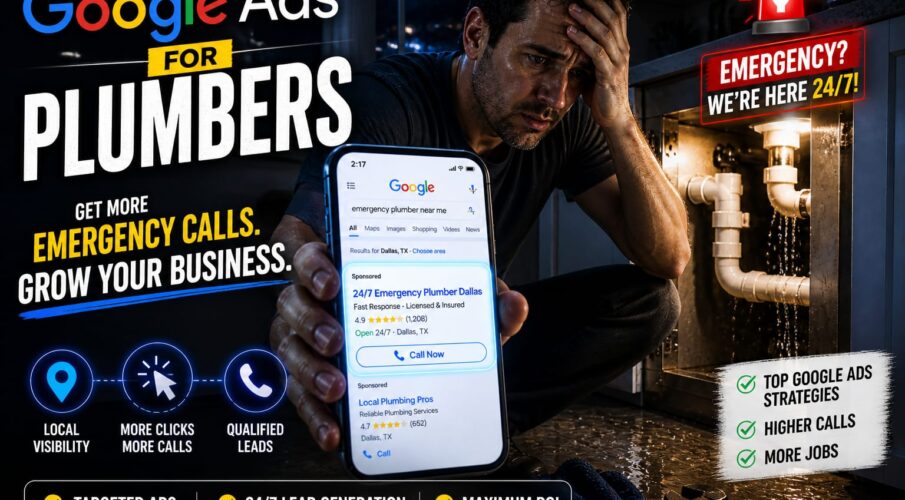
Google Ads for Plumbers | The No-Fluff Guide to Getting More Calls
A burst pipe at 2 a.m. does not wait. Neither does the homeowner scrambling to find a plumber. They grab their phone, type something like “emergency plumber near me,” and call whoever shows up first.
That first result is not luck. It is Google Ads — and if your business is not there, someone else is taking that call.
Google Ads for plumbers is one of the fastest ways to put your business in front of people who need help right now. Not next week. Not after they scroll through five blog posts. Now. The intent is immediate, the searches are specific, and the people clicking are ready to book.
But here is the problem: most plumbers either skip Google Ads entirely because it feels complicated, or they throw money at it without a real strategy and wonder why the phone is still not ringing.
This guide fixes both. You will get a clear, practical breakdown of how Google Ads works for plumbing businesses — what to set up, what to avoid, how much to expect to spend, and how to turn clicks into actual paying customers.
Why Google Ads Makes Sense for Plumbing Businesses
Plumbing has one of the strongest fits with paid search of any home services industry. Here is why.
Most plumbing jobs start with a search. Whether it is a dripping faucet, a clogged drain, a water heater that stopped working, or an emergency leak — homeowners go to Google first. They are not browsing social media or waiting for a coupon in the mail. They are actively searching for a solution, often with urgency.
That intent is gold for advertisers. Compare it to running Facebook Ads, where you are interrupting someone mid-scroll. With Google Ads, you are showing up at the exact moment they are looking for you.
Local reach also works in your favor. Plumbing is inherently local, and Google Ads lets you target by zip code, city, or radius. You are not paying for clicks from cities you do not serve. You can focus your entire budget on the neighborhoods that matter to your business.
And then there is speed. SEO takes months to build. Google Ads can start driving calls within days of launching a campaign — which is why it is often the smartest first investment for plumbing companies looking to grow fast.
Organic vs. Paid: Why Not Both?
SEO and Google Ads are not competitors — they are a team. Organic rankings build long-term credibility and reduce your cost-per-lead over time. Paid ads fill the gap while SEO catches up and capture high-intent searches that are too competitive to rank for organically.
If you are just starting out, Google Ads gets the phone ringing now. Once you have consistent revenue, you invest in SEO to reduce dependence on paid traffic. Smart plumbing businesses run both.
Google Ads vs. Local Services Ads: Know the Difference
Before building any campaign, you need to understand that “Google Ads” actually covers two different products. Many plumbers confuse them, and mixing them up leads to poor strategy.
Standard Google Ads (Pay-Per-Click)
This is the traditional paid search model. You create campaigns, write ads, choose keywords, and pay each time someone clicks your ad. Your ad shows up in Google search results above the organic listings.
You have full control over targeting, ad copy, landing pages, and bidding strategy. The trade-off is complexity — it requires ongoing management to perform well. This is where plumbing keyword research, negative keywords, and ad group structure come into play.
Local Services Ads (LSA)
Local Services Ads are Google’s dedicated product for home service businesses, including plumbers. They appear above standard Google Ads at the very top of the page and show your business name, rating, phone number, and a “Google Guaranteed” or “Google Screened” badge.
The big difference: you pay per lead, not per click. If someone calls you through an LSA, you pay. If they just see the ad, you do not. This makes Local Services Ads for plumbers extremely cost-effective when managed correctly.
Getting LSA-approved requires a background check and license verification, but the Google Guaranteed badge it earns you builds instant trust with potential customers.
Which Should You Use?
The honest answer: both, when possible. Local Services Ads tend to deliver lower cost-per-lead for high-volume services like drain cleaning, emergency calls, and water heater repair. Standard Google Ads give you more control and are better for specific services or geographic targeting beyond what LSA supports.
Many plumbing marketing agencies recommend running both simultaneously for maximum visibility across all placements.
Plumbing Keyword Research: Finding the Searches That Convert
Choosing the wrong keywords is one of the most expensive mistakes you can make in Google Ads. You end up paying for traffic that never converts, burning through budget before you even realize it.
Good plumbing keyword research starts with intent. Every search someone types falls into one of a few categories: they are looking for information, they are comparing options, or they are ready to hire someone. You want to bid on the last group.
High-Intent Keywords Worth Bidding On
These are the searches where someone needs a plumber now or very soon:
- “plumber near me”
- “emergency plumber [city]”
- “water heater repair [city]”
- “clogged drain service”
- “leak repair plumber”
- “same day plumber”
- “plumbing company [zip code]”
These searches indicate real, immediate need. They tend to have higher cost-per-click because competition is stiff, but they also convert at higher rates.
Service-Specific and Long-Tail Keywords
Long-tail keywords are more specific phrases. They tend to have lower search volume but often higher conversion rates because the searcher knows exactly what they want:
- “tankless water heater installation cost”
- “sewer line replacement [city]”
- “bathroom faucet repair plumber”
- “drain cleaning service residential”
For drain cleaning ad groups specifically, build a dedicated ad group with drain-related keywords and ads that speak directly to that service. This improves your Quality Score and lowers your cost-per-click.
Negative Keywords for Plumbing: Stop Wasting Money
Negative keywords are searches that trigger your ad but should not. Without them, your budget leaks on irrelevant clicks.
Common negative keywords for plumbing campaigns include:
- “plumbing jobs” or “plumber jobs” (job seekers, not customers)
- “plumbing supply” or “plumbing parts” (DIYers shopping for parts)
- “plumbing school” or “how to become a plumber”
- “plumbing diagram” or “plumbing code”
- “free plumber” or “plumbing DIY”
Review your search terms report weekly, especially in the first month. You will find searches you never anticipated triggering your ads. Add them as negatives before they drain more budget.
How to Structure a Google Ads Campaign for Plumbers
Campaign structure is not exciting, but it matters more than most plumbers realize. A well-organized campaign is easier to manage, easier to optimize, and produces better Quality Scores — which means lower costs and better ad placement.
The Right Campaign and Ad Group Structure
Think of it in three levels:
- Campaign level: defines your budget, targeting, and network (Search vs. Display)
- Ad group level: groups keywords by theme or service
- Ad level: the actual text ads users see
For a plumbing business, a solid campaign structure might look like this:
- Campaign: Emergency Plumbing — Ad Groups: Burst Pipe, Water Leak, After-Hours Plumber
- Campaign: Water Heater Services — Ad Groups: Water Heater Repair, Water Heater Replacement, Tankless Installation
- Campaign: Drain Services — Ad Groups: Clogged Drain, Drain Cleaning, Sewer Line
- Campaign: General Plumbing — Ad Groups: Residential Plumbing, Local Plumber, Plumbing Company
This separation lets you control budgets by service category, write highly specific ad copy, and send traffic to relevant landing pages — all of which improve conversion rates.
Writing Ads That Get Clicked
Your ad copy needs to do a few things quickly: confirm relevance, establish trust, and give the searcher a reason to choose you over the competition.
For emergency plumbing PPC campaigns specifically, urgency language matters. Phrases like “Available 24/7,” “Same-Day Service,” and “Call Now for Fast Help” speak directly to what someone with a plumbing emergency actually needs to hear.
Always include your strongest differentiators. If you offer upfront pricing, a satisfaction guarantee, licensed and insured technicians, or same-day availability — those belong in your ads, not buried on your website.
Use all available ad extensions: call extensions (so users can call directly from the ad), location extensions, sitelinks to specific service pages, and callout extensions for highlights like “No Overtime Charges” or “Family Owned Since 1998.”
Landing Pages Matter More Than Most Plumbers Think
Sending all your ad traffic to your homepage is a common and costly mistake. A visitor who clicked on “emergency water heater repair” lands on your homepage and has to figure out where to go — and most of them will not bother.
Build dedicated landing pages for each major service or campaign. The page should match the ad exactly: same headline, same service, a clear phone number above the fold, and a simple contact form. Faster load times also matter — pages that take more than three seconds to load will lose mobile visitors before they even see your offer.
Plumbing Advertising Costs: What to Actually Expect
Budget is where most plumbers either give up too early or spend too much without a plan. Here is a realistic look at what Google Ads costs in the plumbing industry.
Cost Per Click in Plumbing
Plumbing is a competitive category. Cost-per-click (CPC) for high-intent keywords can range significantly depending on your city, competition level, and the specific keyword. Emergency and near-me searches tend to cost more because every plumber in your area is bidding on them.
Major metro markets generally carry higher CPCs than smaller cities. Budget accordingly and do not assume that a small daily spend will produce significant results in a competitive area.
What Is a Realistic Starting Budget?
There is no universal answer, but plumbing businesses new to Google Ads typically need enough monthly budget to gather statistically useful data. Too small a budget, and you cannot make meaningful optimization decisions. Google recommends setting daily budgets at roughly 10-20x your target cost-per-click — so if you are targeting keywords at $15 per click, a $150-$300 daily budget gives you enough data to learn.
For Local Services Ads, the dynamic is different since you pay per lead rather than per click. Lead prices vary by market and service type, but LSA is often more efficient than standard PPC for plumbers, especially for emergency and drain services.
Cost Per Lead vs. Cost Per Click
The metric that matters is not cost-per-click — it is cost-per-lead. A click that never converts is worthless no matter how cheap it was. Track your actual lead cost by connecting Google Ads to call tracking and form submission data.
Most plumbing businesses should be thinking about what a new customer is worth over time, not just the first job. A new customer for a drain cleaning call might refer two friends, need a water heater in three years, and call you for every plumbing issue for the next decade. That lifetime value completely changes how you should think about lead acquisition costs.
Targeting That Keeps Your Ads Relevant
Running broad targeting in Google Ads and hoping for the best is how budgets get wasted. Smart targeting keeps your ads in front of the right people at the right times.
Location Targeting
Set your geographic targeting to match your actual service area — not broader. If you serve a 20-mile radius around your city, target that radius. Many plumbing companies make the mistake of targeting too wide and paying for clicks from areas they cannot profitably serve.
For Local Services Ads, your service area is even more tightly defined by zip code, which actually works in your favor for local relevance.
Ad Scheduling
Run ads when your business can actually answer the phone. If you offer 24/7 emergency service, run your emergency campaigns around the clock. If your office hours are 7 a.m. to 7 p.m., schedule your non-emergency campaigns accordingly and reduce bids or pause ads during hours you cannot respond.
A missed call from a paid ad is a wasted ad dollar. Always align your ad schedule with your actual availability.
Device Targeting
The vast majority of plumbing searches happen on mobile devices — someone in a panic with a busted pipe is not sitting at a desktop. Make sure your ads and landing pages are fully optimized for mobile. Consider increasing mobile bid adjustments to prioritize mobile placements for emergency campaigns.
Tracking, Measuring, and Optimizing Your Campaigns
Running Google Ads without tracking is like driving with your eyes closed. You need data to know what is working, what is wasting money, and where to push harder.
Call Tracking
Most plumbing leads come in as phone calls. Standard Google Ads conversion tracking can capture calls made directly from your ads (using Google forwarding numbers), but you may also want a third-party call tracking tool to capture calls from your website after someone clicks your ad.
Call tracking tells you which keywords and campaigns are generating actual calls — not just clicks. This data is essential for optimizing your bids and budget allocation.
Conversion Tracking Setup
At minimum, you should be tracking: phone calls from ads, phone calls from your website, and form submissions. Link your Google Ads account to Google Analytics for deeper behavioral data. Import conversions into Google Ads so the platform’s bidding algorithms can optimize toward leads, not just clicks.
Key Metrics to Watch
Focus on these metrics weekly:
- Click-through rate (CTR): are people clicking your ads? Low CTR suggests weak ad copy or poor keyword match.
- Conversion rate: are clicks turning into leads? Low conversion rate usually points to a landing page problem.
- Cost per conversion: what are you actually paying per lead?
- Search impression share: how often are your ads showing for relevant searches?
- Quality Score: Google’s rating of your keyword relevance, ad relevance, and landing page experience.
Continuous Optimization
Google Ads is not a set-it-and-forget-it system. Effective management involves reviewing search term reports, testing new ad copy, adjusting bids, refining negative keyword lists, and periodically restructuring campaigns based on performance data.
This is why many plumbing businesses work with a plumbing marketing agency or a Google Ads management team that specializes in home services. The time investment required to run campaigns well is significant, and the expertise gap between a well-managed campaign and a neglected one is enormous.
When to Manage Google Ads Yourself vs. Hire a Specialist
This is a legitimate question, and the honest answer depends on your situation.
Self-managing Google Ads makes sense if you have time to learn the platform properly, you are in a less competitive market, and your monthly ad spend is modest enough that management fees from an agency would eat up a significant percentage of your budget.
Hiring a Google Ads management specialist or plumbing marketing agency makes sense when you are in a competitive metro, your monthly spend is substantial, or you have tried to run campaigns yourself and the results have been disappointing. A specialist also brings experience with what already works in the plumbing industry — keyword lists, ad copy angles, campaign structures — which shortens your learning curve and reduces wasted spend.
If you do hire outside help, ask specifically about their experience with plumbing or home services accounts. General agencies that pivot to plumbing accounts often miss industry-specific nuances like seasonal search trends, the importance of emergency-focused campaigns, or how to structure drain cleaning ad groups for maximum Quality Score.
Search Engine Marketing for Plumbers: The Bigger Picture
Google Ads does not exist in isolation. Search engine marketing for plumbers works best when it is part of a coherent digital marketing strategy.
Your Google Business Profile (the listing that appears in Google Maps and the local pack) directly influences your Local Services Ads performance. A well-maintained profile with consistent reviews, accurate hours, and up-to-date service categories makes your LSA campaigns more effective.
Your website quality directly affects your Google Ads Quality Score. A slow, poorly structured website will cost you more per click and reduce your ad placements, even if your bids are competitive. Investing in a fast, mobile-friendly site with strong service pages pays dividends across both your paid and organic performance.
Your review volume and average rating affect both LSA performance (Google uses these to rank LSA listings) and overall conversion rates. Someone comparing two plumbers in Google Ads results will almost always choose the one with more reviews and a higher rating, even if both ads say similar things.
Frequently Asked Questions
How much should a plumber spend on Google Ads per month?
There is no single right answer — it depends on your market size, competition, and goals. In smaller markets, a few hundred dollars per month can generate consistent leads. In major metro areas, effective campaigns often require significantly more. The key is starting with enough budget to gather real data (at least a few weeks of meaningful click volume) before drawing conclusions about performance.
What is the difference between Google Ads and Local Services Ads for plumbers?
Google Ads (standard PPC) charges per click and gives you full control over keywords, ad copy, and targeting. Local Services Ads appear above standard ads, charge per lead (not per click), and include a Google Guaranteed badge. Many plumbers benefit from running both. LSA is often a better starting point for new advertisers because of its simpler setup and pay-per-lead pricing.
How long does it take for Google Ads to work for a plumbing business?
You can start receiving clicks and calls within days of launching a campaign. However, meaningful optimization — where you have enough data to confidently adjust bids, pause poor-performing keywords, and improve conversion rates — typically takes four to eight weeks. Expect the first month to be a learning period rather than peak performance.
What keywords should plumbers avoid bidding on?
Avoid keywords where the searcher is not looking to hire a plumber: job-seeker queries (“plumber jobs”), DIY queries (“how to fix a leaky faucet”), supply queries (“plumbing parts”), and informational queries without service intent. Build and maintain a negative keyword list and review your search terms report regularly to catch irrelevant traffic.
Do plumbers need a landing page, or can they send traffic to their homepage?
Dedicated landing pages nearly always outperform homepages for paid traffic. A landing page matched to a specific ad and keyword gives visitors exactly what they clicked for, reduces confusion, and increases the likelihood of a call or form submission. For high-volume campaigns or expensive keywords, landing page quality is one of the highest-ROI improvements you can make.
Should I hire a Google Ads agency or manage plumbing ads myself?
Self-managing makes sense for small budgets and less competitive markets if you are willing to invest time in learning the platform. For larger budgets, competitive cities, or businesses that have struggled with DIY campaigns, a plumbing marketing agency or Google Ads specialist with home services experience typically delivers better results and prevents costly mistakes.
The Bottom Line
Google Ads for plumbers works — when it is set up properly, managed consistently, and connected to the rest of your digital presence.
The businesses winning with paid search in plumbing are not spending the most money. They are spending it smarter: on tightly targeted keywords with real intent, in geographic areas they can actually serve, with ad copy that earns the click and landing pages that earn the call.
If you are starting from scratch, begin with Local Services Ads. The setup is simpler, the cost structure is lower-risk, and the Google Guaranteed badge alone can lift your conversion rates. Then layer in standard search campaigns as you learn what your market responds to.
If you are already running ads but not seeing results, the problem is almost always in one of three places: the keywords are too broad, the landing pages are too weak, or the tracking is missing so you cannot tell what is actually working.